by caratgmi

Fiat's latest TVC generates BIG hits

Online Shopping- Hotter than before?

Ever wondered what the WWW. SPHERE really looked like?

Showing posts with label marketing. Show all posts

Monday, 13 October 2014

What Automotive Marketers Stand to Gain From Multiscreen Campaigns $11 billion through 2018 

  • October 12, 2014, 9:58 PM EDT
  • Sponsored

Today’s car shoppers are universally connected, and today’s automotive marketers understand the characteristics and demographics of a good, qualified buyer. Yet conventional targeting methods are less effective than ever, thanks to the proliferation of channels, screens and digital choices.
On average, consumers who are near- or in-market can be expected to research a vehicle on nine different websites, half of which are controlled by third parties. Consequently, automotive advertisers must position themselves to be both local and relevant, and that means targeting the right audience through digital channels.
Through a combination of in-house profiling, past purchase data, and rich demographic insights, marketers can define and then target near- and in-market consumers with solutions like Collective Wheelhouse, which effectively merges online and offline data and insights from JD Power, Insight Express and Nielsen XCR.
The US Automotive industry’s digital advertising spend is expected to grow to nearly $11 billion through 2018. Learn more about using multiscreen programmatic solutions for your next automotive campaign by downloading the full text of our free guide:

Thursday, 29 May 2014

GM Chevrolet CMO's Tips on Building a Marketing Strategy from Scratch


GM Chevrolet CMO's Tips on Building a Marketing Strategy from Scratch
Image credit: chevrolet.com
Performance Data Recorder
ust when the marketing industry was getting a handle on effective digital and social media, new forces are changing the game yet again: real-time marketing and big data.
Deanie Elsner, CMO at Kraft, says her team has access to two “looking glasses” of giant dashboards that display real-time consumer data; there they can instantly respond to every consumer’s whimsical craving with special, targeted deals.
Laura Henderson of Mondelez International, the makers of snacks like Oreo, Chips Ahoy and Dentyne, says they operate in a “war room structure,” with a calendar of anticipated events. Teams of Mondelez marketers, lawyers and corporate communication professionals convene to make game-time decisions on the right moment to deploy a campaign. But it has to be the right moment.
Startups don’t have a multi-million dollar marketing budget to employ a full-time marketing army, or build a mission control center for big data. But as Henderson said at The Economist's 2014 Big ReThink summit, “You need to start with a cultural transformation. You need the real-time agility to enable empowered marketers and your organization to strive and react to social factors.”
But as innovation continues to transform the rules of engagement with consumers, how else can startups keep their marketing up to date? Furthermore, how can startups weather early-stage crises?
Tim Mahoney, Chief Marketing Officer of Global Chevrolet and Global GM Marketing Operations Leader, agrees that brilliant marketing isn’t about budget, but about identifying your audience's passion point. For new companies building a strategy from scratch, Mahoney says to start at square one: “If you’re an entrepreneur, you already have a passion because you’ve taken that leap, so draw on that empathy. My advice is to try to find the perfect intersection of what your product stands for and the consumer’s passion point. Understand your own customer’s passion point so well that everything falls into place. It can be reduced to that.”
Mahoney is also managing the GM brand through its worst crisis since emerging from bankruptcy in 2009. He recently told the Detroit Free Press that the company is "staying focused on the product" and that he is sticking to his marketing strategy despite the recent recalls. To fully grasp Mahoney's "passion point" strategy, we asked him to list and explain his own favorite marketing campaigns:
1) GM centers pickup ads on this messaging because it evokes strong emotions: If you own a pickup, you have more friends. “It can spring a whole variety of reactions.”
Here is a recent actor-free ad:
2) Mahoney’s team knows Corvette-drivers are generally as passionate about high-tech as they are about sports cars. So at the most recent Consumer Electronics Show, GM announced they will mount GoPro performance data and video recorders to the 2015 Chevrolet Corvette models. Drivers will be able to record, share and playback drives (when parked) on the eight inch touch-screen. “You can imagine Corvette drivers are going to want to start recording as they cruise around. It’s all about finding that tool that sets the brand apart,” he says.
3) He even gave Honda kudos for being the first automaker to install vacuum cleaners in their minivans. “It debuted at last year’s auto show,” said Mahoney. “It showed a commitment to their consumers’ lifestyles.”

Monday, 7 October 2013

Chinese auto marketing shifts from TVCs

BEIJING: Auto brands advertising in the Chinese market are reporting strong results from both product placement in movies and standalone branded micromovies, to the extent that the latter channel in particular could supplant TVCs.

More than 100 companies released brand micromovies on film and at online portals during the final quarter of 2012, according to a report from Bale Hudong (Beijing) Media Co. In addition, these companies had also arranged product placements in close to 500 micromovies.

Volkswagen has successfully utilised this route, bringing Hollywood star Keanu Reeves on board for a micromovie, Extreme Pursuit, as part of its China Sports Car Project. This featured Reeves alongside brands such as Volkswagen, Audi, Bentley, Bugatti and Lamborghini.

"We are integrating marketing, film and social media in an engaging and fascinating way," Markus Nels, director of the Sports Car Project, told China Daily.

"The micromovie brings together intelligent product placement with Chinese and Hollywood stars to deepen Chinese consumers' understanding and appreciation of world-leading sports cars," he added.

Others saw the micromovie as offering better targeting than more traditional media. Gao Fang, vice-general manager of automaker FAW Toyota, indicated that it was a perfect vehicle to reach its intended audience of young and fashionable consumers.

"The combination of advertising and a film story can be easily accepted by young consumers," he noted.

Gao also saw this channel developing further, adding that "due to the unexpected market response, micromovies may replace TV commercials as the major marketing tactic for automakers in the near future".

His view was echoed by Huang Weichong, public relations manager with FAW Volkswagen, who said that a new micromovie for the marque's CC model had received 40m visits in two months. "We see a better result than with TV commercials," he added.

Chinese automakers are also looking to the big screen to make an impact globally, with Guangzhou Automobile Group's Trumpchi E-jet, a hybrid vehicle, featuring prominently in the latest film in the Transformers series in order to improve brand awareness internationally.

A recent online survey at Sina.com showed that almost 60% of respondents believe that seeing a vehicle in a film helped promote the brand's image, while 33% thought it made people more likely to purchase such a car.

Data sourced from China Daily; additional content by Warc staff, 7 October 2013
http://po.st/kE8SY7

Wednesday, 2 October 2013

Chevrolet Ranked 89 Top Global Brand by Interbrand

Read more here: http://www.interbrand.com/en/best-global-brands/2013/Chevrolet

Shifting Gears: How Consumers are Steering Auto Brands’ Future


By Michel Gabriel and Andrew Martschenko

Automakers are grappling with the mobility needs of tomorrow, changing their strategies according to customer needs worldwide. Consumers want value for money at all price points, with traditional notions of ownership evolving. High- growth markets still value the vehicle as a status symbol with many of these car buyers participating for the very first time. In more mature markets, the growth in actual miles driven per person is declining and alternatives such as car-sharing options and the adoption of more flexible models are prevalent.
These trends are industrywide. Urban youths across markets are seeking car-sharing options. Customization, innovation, and sustainability are key, along with in-car connectivity and smart features. The auto sector is evolving, weighing tech must-haves versus nice-to-haves. Many global automakers are now embedding technologies that would have launched with their premium brands first but have opted to directly offer in their high-volume vehicles. Other considerations shaping auto brands’ outlook:
Shifting populations
The recent influx of people into big cities has compelled brand owners to take urban mobility concepts seriously. Demographic trends such as the “down-aging” of older but more active and plugged-in consumers are forcing brands to ask themselves: How can brands actively connect with the younger end of the spectrum while remaining desirable for the youthful older generation?
The evolution of luxury
Consumption is changing, too, as quality of life begins to outweigh (in some markets) status and luxury. On the one hand, there’s a desire for the exceptional and the exclusive; on the other, a disdain for excess and waste. As time spent enjoying the sensual pleasures of the driving experience becomes a luxury in and of itself, car brands must address the diverging needs of consumers, especially those truly seeking the luxury automotive experience—not to mention luxury car buyers in fast-moving markets. Everything must be re-evaluated—the choice/purchase process, the range of services offered, supply chain and sustainability metrics, partnerships, managing the brand experience, and digital and social marketing.
A new kind of brand leader
The successful auto brand leader must inspire employees, sales partners, manufacturers, partners, stakeholders—and, of course, customers. The automobile industry is undergoing a transformation, and the CEO and the CMO must point to the horizon in 2023. That’s where the opportunities lie, and it’s also where the greatest rewards will be reaped. That is where each brand must go to ensure it stays relevant in its sector.

Thursday, 19 September 2013

Toyota's Ad Demonstrates How Not to Sell Cars

The New Corolla Commercial Is Full of Abstractions and Self-Reflection

By:

I can imagine the roomful of dealers when Toyota debuted the primary TV commercial for its campaign to launch the 2014 Corolla. Called "Style Never Goes Out of Style," it shows various past Corolla models surrounded by period-appropriate dancers, music and schtick. Even after hearing about the extensive research and intent that went into its creation, the dealers must have begun to madly calculate how they were going to sell the cars in spite of it.

The ad provides a textbook case in mistakes to avoid when you contemplate your next campaign, with these four broad points to keep in mind:


The days of announcing branding are over. No ad can say a brand is "cool" or "different," or credibly claim any other quality, since consumers are too cynical and distrusting to believe it anymore. The Toyota spot expends considerable time and obvious expense to declare that the Corolla has always been "with it," when we know it has been mostly a boring, utilitarian and otherwise highly successful model. MTV had a saying long ago that if you had to say you were cool, you weren't. Corolla isn't.


Self-reflection isn't differentiation. Nobody is ever going to love your brand as much as you do unless, like you, they're paid to feel that way. The company's press release about the new Corolla touts many design changes that must be important internally, but from the glimpses that the outside world is given in the spot, it looks like, well, every other car in its category. There's something almost satirical about how the new model is presented (wholly unintended, I'd expect). The dancers are more memorable.

Complicated research conclusions are doomed. The company says that its extensive research told it that 1) Millennials are looking to upgrade their careers, 2) they're looking for a "real" car to get them there, and that, implicitly 3) the Corolla campaign should continue the momentum of the company's Let's Go Places brand direction. Not only does little of that make any sense (most notably, Millennials don't see cars as symbols the way their parents did), but how Toyota got from that to the TV spot is beyond me.

Repetition of nonsense is still nonsense. The ad is part of a vast campaign, so it could be defended with the breakfast cereal gambit ("sure, there's no nutrition in the box, but when served with an apple and glass of orange juice, it's part of a balanced breakfast"). Toyota lists all of the mobile, social and experimental components that comprise the campaign, but they seem to all propagate the same nonsense. There's something to be said about staying "on brand," but not to the exclusion of saying anything useful to anybody.
I'm not as much surprised as saddened that such nutty beliefs and misconceptions about advertising (and marketing overall) can lead otherwise smart, creative people to squander their effort, money and the patience of would-be consumers. I'm sure there are binders full of rationale for why it's stunningly brilliant stuff, and there'll be metrics that declare the spot a wild success. But believing those arguments, or valuing those outcomes, requires that you first ignore the four truisms I stated above.

Advertising used to be about communicating information that was memorable, meaningful and useful. By those measures, the new Corolla spot delivers only an unintended punch to Toyota's dealers, who probably need to meet really high sales quotas. Doing so is going to require a lot more than people dancing around cars.

ABOUT THE AUTHOR
JONATHAN SALEM BASKIN is the author of "A Thousand Words: Why We Must Fight The Tyranny of Brief, Vague & Incomplete," and the president of Baskin Associates, a marketing consultancy. You can follow him on Twitter: @jonathansalem.


Tuesday, 10 September 2013

GM’s Michael Savoni on Why You Need a Customer Service Twitter Handle


Communities have changed a lot in the past few years, having manifested online in ways no one could have previously imagined. Still, some things have stayed the same. Social networks allow people to broadcast their views much the way they do in person, but often with much greater reach. Much of the time those opinions are positive, is your brand ready to respond when they’re less than complimentary?
As more companies are realizing, online conversations are varied and complex. While this fact is daunting, it also points to a great opportunity: To join conversations and provide value to customers who are asking for it, and even those who aren’t.
One of the best ways to join these conversations is to create a Twitter handle dedicated to serving customer needs that is separate from your business’ main account. Not only does this approach prevent dilution of brand messaging on your main account, it also gives you a way to provide meaningful content and tips from a valid source. It’s the same reason most companies have dedicated customer service numbers.
We think one of the brands doing this right is GM, so we chatted with Michael Savoni, the company’s social media business process lead. In his combined customer service, marketing and PR role, he oversees the @GMCustomerSVC,@ChevyCustCare, @BuickCustCare, @GMCCustCare, and @CadillacCustSVCaccounts from headquarters in Detroit, MI. Here are his tips for maintaining a strong customer service Twitter handle.

Jump in First

According to Savoni, customer service on Twitter is as much about listening to existing conversations as it is about reaching out yourself. In GM’s command center, social media agents track social chatter across numerous screens, where they follow everything from specific brand mentions to tweets about searching for a new car.
When someone reaches out for advice or with concerns, agents respond with an answer or suggestions to resolve the problem. But simply responding to customer concerns is not enough. Savoni encourages reaching out to people on Twitter before they ask for help.
“We don’t want to just be a robotic team responding to people who have issues. We want to be out there and help them,” he says. Recently, GM expanded its social media team with 15 new hires, whose job it is to jump in when an individual on Twitter expresses a request or concern that can be addressed by the brand.
“We hired these 15 new social media agents who are out there building relationships with our customers so that from a pre-sale and post-sale perspective, our customers know that they can go to them,” Savoni says. “From the pre-sale side, somebody may just say, ‘Hey, I’m heading to the dealership tomorrow. I’m excited to look for a new car,’ and our team is out there to say ‘Is there anything I can help you with?’”

Be What You Are: Human

While different brands have unique voices, when it comes to customer service on Twitter, putting forth a friendly, helpful persona is essential. GM did this by taking its five best call center representatives and training them to respond to customer concerns online back when it created its dedicated accounts in 2009. Today, three of those original five oversee GM’s Customer Care team.
The lesson here is to look for people who are comfortable creating a professional yet approachable rapport with customers in person or on the phone—odds are that personality will translate well online, too. Savoni describes those call center representatives as professional, playful and understanding. In an industry where issues such as safety and recalls are serious concerns, it turns out that the majority of the 700 monthly customer care conversations focus on less serious issues.
“In a typical customer case, the customer is not coming with a major problem, they’re just looking for something that they can get a little bit of help with. From a pre-sale perspective, it is a very fun conversation,” Savoni says. “We want our agents to get in there and have a little fun with them.”
To take the human touch to another level, GM Customer Care agents sign tweets with their initials to indicate who has responded to each query. Plus, Savoni says each of the backgrounds on the company’s Twitter pages will soon include photos of the social media agents, as well as their personal handles to show that they really are human.

Coordinate, Coordinate, Coordinate

At GM, the social media team members are assigned to different initiatives, such as Marketing, PR and, of course, Customer Care. Those teams engage in more than 70,000 conversations per month on Twitter, Facebook and online forums. With such a high volume of interactions, it is essential for each leg of GM’s self-proclaimed “three-legged stool” to be aware of the others’ actions.
This is especially important in times of crisis, such as recalls, or during key marketing campaigns. “When Marketing and PR are launching new vehicles or building out programs that maybe have a large social component to them, it’s important to keep our social customer care team involved. That’s going to drive a lot of conversations and traffic that could potentially stem some opportunities for our Customer Care team to get involved pre-sale or post-sale,” Savoni says.
Customer service is all about answering questions, so when your company is pushing new information into the world, it’s important to keep track of the questions it may create. With regular meetings bringing together all these teams, your customer service agents will be aware of new information before it gets to the public, allowing them to be ready for whatever may come.
When it comes to serving customers, Twitter is a fast and easy way to respond efficiently to consumer concerns. What’s important, though, is to treat managing your online customer service strategy the same way you would a phone strategy. By creating relationships based on helpful, earnest conversations, a customer service Twitter handle can help your brand show your customers you really care.
[Image credits: GM]
http://sproutsocial.com/insights/2013/05/customer-service-twitter-handle/

Friday, 2 August 2013

Twitter on Ad Retargeting Bandwagon

 
Taking a page from Facebook FB +1.87%, Twitter said it will start experimenting with using people’s Web behavior to tailor ads on the short-messaging service.
Twitter in a blog post Wednesday said that a florist could opt to use data on who visits its website to target ads to those people when they are using Twitter. The San Francisco company also said the florist could take a list of his email subscribers and pitch ads to those people if and when they are on Twitter.
This ad targeting is similar to two types of Facebook ad formats, known as FBX and Custom Audiences, respectively.
Facebook and now Twitter are taking more advertising cues from old-school Web sites such as Yahoo YHOO -0.46%, which long have tracked users across the Web for ad purposes. For example, they would use data about a user’s visit to a Chevy website to show that person Chevy ads when they surf elsewhere. Facebook started offering the so-called retargeting ads recently, and advertisers have embraced it in a big way.
The retargeting efforts muddy the original advertising philosophy of Facebook, Twitter and other social media services. The promise was that ads tailored to “social signals” — checking into a Mexican restaurant on Foursquare, or “liking” a Nike NKE +4.85% shoe on Facebook — helps generate better ads than traditional digital banner ads. But Facebook’s and Twitter’s embrace of ads based on prior website visits and email lists may be a sign that new digital ad models will mix in plenty of elements from old ad models.
Kevin Weil, a Twitter ad-product executive, said that the company continues to back new kinds of ad models based on what people tweet, the types of accounts users “follow” and other social signals. But he said it also makes sense to meld in established digital-ad techniques like retargeting when it results in a more useful ad. 
Twitter said it is starting slowly with its new ad efforts, and testing it first only in the U.S. with a small number of advertisers. The company said it may expand those new ad features if they prove popular with users and advertisers.
Consumer advocates have raised concerns about privacy implications as more digital services leverage more Web behavior and data to target ads. In its blog post, Twitter touted its privacy-friendly features, such as the ability for users to check a single box to opt out of allowing advertisers to tap their information to tailor ads on Twitter. Those people will continue to see ads on Twitter, however.
In a blog post, digital-privacy organization Electronic Frontier Foundation praised Twitter for its user-privacy features in advertising.

Suzuki chooses responsive design for new emag

8 July, 2013

Suzuki has launched a new emagazine Way of Life in hand with custom publishing house Edge, using responsive design. The design format aims to cater to the ever expanding market of tablets and smartphones by rearranging content according to the device being used, countering the need to build different sites for Android, Apple, desktop and mobile.

Edge’s head of strategy, Richard Parker says the focus shouldn’t be on trying to scale a website into every possible screen size available.

“Instead, we should be starting to think about content and the environments in which it will be consumed and the context in which it will be consumed in, then from this, create the right web properties to meet these needs.”

Some perceive responsive design to be having a few teething problems. Websites built with responsive design can experience delayed loading of images and content, and issues with the formatting of advertisements.  And being relatively new technology, it can be quite an expensive option. However, Parker says the supposed slow load time comes only when compared to native apps, or when a site is primarily image-based.

“The uptake of 4G for mobile networks will greatly improve this as will the NBN with its high speed broadband.”

Suzuki has been one of the first automotives to choose responsive design with the guidance of Edge for Way of Life. The online publication covers vehicle launches, promotions, travel stories and news about the brand, and is sent to more than 100,000 Suzuki fans across multiple devices.

“Responsive design works well for the [Suzuki] site because its architecture and functionality is quite simple and streamlined. If it were a more detailed site and had utility or e-commerce components this would make responsive quite difficult to achieve,” says Parker. 

Edge’s director Fergus Stoddart said the company recognised Suzuki’s audience used multiple devices and a multi-screen solution was required. “A responsive design, while maybe costing a little more, will ensure the entire Suzuki customer database has access to the new e-magazine,” Stoddart said.  

Suzuki Australia’s national communications manager, Andrew Ellis said, “Until now, Suzuki didn’t have a way of regularly communicating with our customers, other than through our annual print magazine. This new online channel will provide a digital touch point to our growing customer base, as well as our dealer network.”

“Once again, the team at Edge has made the promotion of Suzuki into the digital realm a seamless one,” Ellis added. 


Tuesday, 18 June 2013

Audi taps veterans’ skills to reach US sales goals

By  Published on May 30, 2013
http://www.luxurydaily.com/audi-taps-veterans%E2%80%99-skills-to-reach-us-sales-goals/
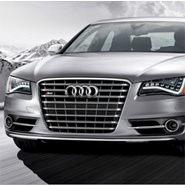
Audi S8 model
Audi of America is helping those who served in the United States military by launching a new program for skilled technicians to work in its dealerships.
The new “Veterans to Technicians” program aids veterans in finding employment and allows the German automaker to maintain its high quality of craftsmanship. Since Audi is looking to break its record sales in the U.S. this year, the automaker is looking for the best employees to help get it there.
“We are forecasting strong growth of Audi vehicles in operation based on the positive gains the Audi brand is achieving the U.S. market,” said Reinhard Fischer, director of strategy at Audi of America, Herndon, VA.“To deliver the service quality and the timeliness of booking appointments that our customers expect, we need to increase the number of technicians in our dealership.
“Audi is not alone with this challenge, as the overall auto industry is forecasting a shortage in technicians,” he said. “But we decided to seek a special, out-of-the-box concept to address this need.
“Further this also supports our duty as a company operating in the U.S. to give back to the communities that are our home. It is a benefit for all involved parties and it is the right thing to do.”
Veterans to Technicians
Audi reported record sales last year and is expecting to break that record this year. The automaker intends to sell 200,000 new cars per year before 2020.
Since Audi plans to be increasing the number of cars sold in the U.S., it estimates that the demand for skilled technicians will also increase.
Therefore, Audi is recruiting veterans who have automotive knowledge, leadership skills and uncompromising values. However, those with power generation, aviation, welding, electronics, hydraulic systems and maritime systems experience will be considered as well.
This program supports the Veterans Opportunity to Work to Hire Heroes Act, which provides federal support for veterans leaving the military and for employers.
The automaker created this program with the help of CALIBRE, a management and technology service company that helps the U.S. Department of Defense and the Department of Veterans Affairs create support programs for service members leaving the military. CALIBRE will help connect veterans to Audi dealerships.
After a background check and screening process, those veterans chosen by Audi will undergo the FastTrack two-week training program to learn about Audi products and technologies to become certified technicians.
To spread the word, Audi created a Web site that gives the details of the Veterans to Technicians program. The site can be accessed at http://www.audivets.com.

Veterans to Technicians Web site
Since finding quality technicians can be difficult for luxury automakers, Audi is tapping a strong group of skilled potential employees.
“Finding qualified technicians is one of the most challenging tasks facing an independent dealer,” Mr. Fischer said. “It is one of the tasks where the manufacturer and dealers need to work together to find good quality candidates that bring the right skills, the right attitude and train them together on all things Audi.
“The dealer benefits by receiving strong candidates who have been prescreened and the dealers can then focus on finding the right fit into the culture and specific needs of the store,” he said.
“It also benefits the dealer since Audi has a predefined training program for the new technicians, which is optimized for delivering Audi product and cultural knowledge in a compact format.”
Ahead of the competition
Audi is focusing on its U.S. goals of becoming the No. 1 luxury auto brand and has already made some improvements to its U.S. strategy.
For instance, Audi is investing $5 billion in three years to expand and update its showrooms to help boost the brand’s presence in North America.
The automaker recently opened a new flagship showroom in New York with its sister brand Volkswagen, which is the largest real estate investment by the Volkswagen Group. Audi is aiming for the showroom and dealership updates to increase its exposure in New York and the U.S. (see story).
Also, the automaker is making the most of its placement in the Iron Man 3 movie which debuts May 3.
Audi announced that it will again be featured throughout the entire third installment in the Iron Man series, after having a prominent place in the first two. A placement like this in a large feature film could give Audi an additional boost in a highly competitive luxury auto market (see story).
In addition to helping Audi reach its sales goals and helping veterans find employment, this initiative also increases Audi’s customer service.
“Customer delight is one of the core missions of Audi and is heavily influenced by the ownership experience,” Mr. Fischer said.
“By having highly qualified technicians in our dealerships we can make sure that we can react quickly to the customers need as well guarantee that repairs are done in high quality, which drives the positive image of Audi in the eyes of our customers,” he said. “
“The program also allows us to show that Audi is a good citizen and joins with this program the good cause of supporting our veterans to transition from the military times to a solid civilian job, recognizing them for their personal sacrifice.”

BMW sparks M series buzz among auto aficionados

By  Published on June 3, 2013
http://www.luxurydaily.com/bmw-targets-auto-aficionados-via-new-m-series-site/
BMW M3
BMW of North America is reigniting auto aficionados’ interest in its M series vehicles through a new Web site.
The German automaker is showcasing its M vehicles through a new Web site that includes details on the M models, their features and their history. BMW is likely trying to target auto enthusiasts and show its innovative side to remain competitive with other luxury automakers.
“The Web site is designed to keep readers engaged, build the car of their dreams and learn more about the brand,” said Lauren Fix, automotive expert and author of “Lauren Fix’s Guide to Loving Your Car,” Lancaster, NY.
“Many BMW lovers will spend at least 20-30 minutes on the site,” she said.
Ms. Fix is not affiliated with BMW, but agreed to comment as an industry expert.
BMW was unable to comment before press deadline.
Powerful letter
BMW’s new microsite for its M vehicles can be accessed at http://www.bmwusa.com/Standard/Content/Explore/Experience/mseries.aspx.
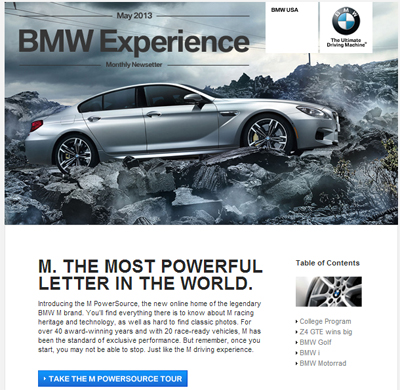
The automaker sent out an email to its customers featuring the M Powersource Tour that takes consumers through an online tour of the M series.
Email
The email contains a call to action on a button that reads, “Take the M Powersource Tour.”
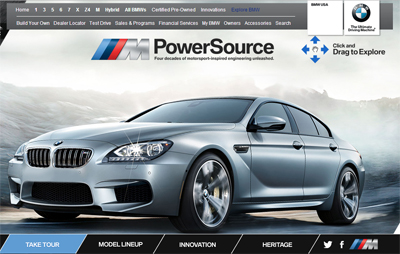
A click through on the button leads consumers to the M Web site where consumers can learn about the M models, innovation and heritage.
Web site
Also, the site allows a 360-degree exploration through clicking and dragging the site around to explore the M series.
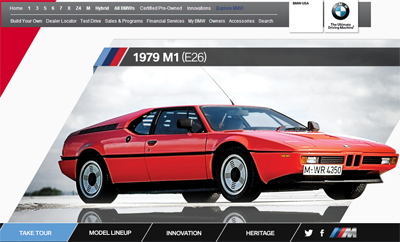
Under the model lineup tab, consumers can view current vehicles, past vehicles, special editions and historic collections.
1979 M1 vehicle
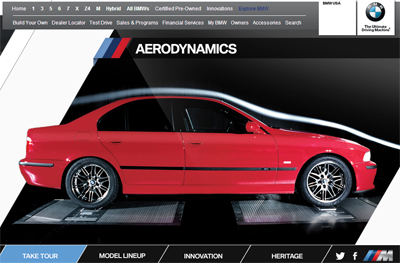
The efficiency tab contains information about the M series’ power, efficiency and handling.
Aerodynamics
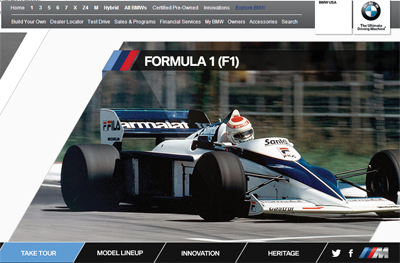
Lastly, the heritage tab offers information on the race series, drivers, racing vehicles and milestones.
Formula 1
This site is likely to catch the attention of many BMW fans who will spend time learning about the history and innovations of the M series.
“BMW M-car owners are passionate about the brand, they love cars that perform at stated and enjoy a true German driving machine,” Ms. Fix said.
Race to the top
BMW continues to push its brand forward by flaunting its innovations to stay ahead of competitions.
For instance, BMW is aiming to beat out the competition by pushing its i concept electric vehicles with the i3 set to be in-stock this year.
Since electric vehicles are a new product to many consumers, automakers that introduce them to consumers should develop strong marketing campaigns to convince consumers to buy the new technology. It seems that electric vehicles can help automakers get ahead of its competitors because there are more environmentally-conscious affluent consumers (see story).
Also, the automaker revamped its core branding efforts with an updated sound logo that is played at the end of television and radio spots.
The melody is incorporated into BMW’s video and audio branding campaigns to further engage consumers through sound recognition value. The tune is being introduced worldwide this year (see story).
By promoting its M vehicles, BMW is specifically targeting car lovers and brand enthusiasts to hook them into the next generation of performance vehicles.
“These vehicles targeted to real auto enthusiasts,” Ms. Fix said. “For those of us that owned or own older cars that don’t offer the safety, but do offer the performance, [these vehicles] are the best of both worlds.
“Many of the performance owners race cars, go to club on-track events and have created a cult following,” she said.
“BMW M-Series cars are true car lovers.”

Toyota tops brand value survey

Matt Campbell
Published: May 22, 2013 - 10:31AM


Toyota has taken top spot as the world’s most valuable car brand, according to the annual Millward Brown Brandz Top 100 survey.

Toyota was beaten last year by German maker BMW after a string of natural disasters took their toll on the Japanese maker’s operations in its home country and in Thailand, but it clawed its way back to post a 12 per cent increase to its global brand value in 2013 and is now rated at $24.5 billion.

Click here to see the full Top 100 rankings list

Toyota jumped five positions up the Brandz rankings in 2013, taking 23rd spot. Topping the list as the most valuable brands were Apple, with a worth of $185.1b, followed by Google ($113.7b), and IBM ($112.6b).

According to Millward Brown, Toyota’s increase followed on both from it having “rehabilitated a reputation for reliability compromised by the recall problems of 2010”, and also due to its focus on hybrid technology and lowering the cost of ownership for buyers.

BMW saw a two per cent drop in its brand value on the back of the European market slowdown, and ranked in 24th position with a brand value of $24.0b. However, German luxury car brand Mercedes-Benz's value rose by 11 per cent to $18.0b on the back of a number of new product launches, jumping three places to 43rd most valuable brand.   

"The automotive brands that grew the most were the ones that launched the most models," Millward Brown global brand director Peter Walshe told US site Automotive News. This shouldn't be a problem for both BMW and Toyota in the coming years, with the two top-ranking brands having signed an agreement to collaborate on a number of new models in the future. 

"Brands must continue to meet the expectations they raised in 2012 for improved quality and luxury features at all price points, helping them to attract younger customers and cultivate a future clientele," Walshe is quoted as saying.

Honda dropped six spots to 71st with a value of $12.4b (down two per cent), while Nissan’s brand value rose to $10.2b (up three per cent) but it fell down five spots in the ranks. 

Volkswagen – the brand that hopes to become the number one-selling nameplate globally by 2018 – came in 100th position with value of $8.8b, a jump of three spots on last year.

A number of car brands just missed the cut for the Top 100, including Ford ($7.6b – up eight per cent), Audi ($5.5b – up 18 per cent), Hyundai ($4.0b – up 11 per cent) and Lexus ($3.5b – up two per cent).

 This story was found at: http://www.smh.com.au/drive/motor-news/toyota-tops-brand-value-survey-20130522-2jzzn.html
Aegis Media 2012. Powered by Blogger.