How electricity lost its spark
Toby Hagon Published: March 16, 2013 - 9:08AM

In taking the wraps off the game-changing Chevrolet Volt hybrid in 2008, then General Motors boss Rick Wagoner said the much-hyped car was about reducing motoring's reliance on oil.
''A great way to open our second century,'' was his introduction to a car claimed to cost less to run daily than a cup of coffee.
The Volt - which went on sale in Australia with a Holden badge last year - was the first petrol-electric car to have batteries that could be recharged from a household power point. Sales have been slow, as predicted, mainly because the Volt's $60,000 price tag is about $20,000 above similar petrol-powered cars.
The thinking behind plug-in hybrid vehicles makes sense. Most people drive short distances daily and would be happy to use electricity, rather than fuel. But for longer distances, a traditional engine can recharge the batteries or help power the car, extending the range of the PHV or PHEV (for plug-in hybrid or plug-in hybrid electric vehicle, depending on who's concocting the acronym) to that of a normal petrol-powered car.
The technology is becoming widely accepted as the way forward for hybrids, with most manufacturers following GM's lead.
It also threatens the future of pure electric vehicles, as GM's Volt has comfortably outsold the all-electric Nissan Leaf and Mitsubishi i-MiEV in the US.
The first clue that the Volt was a landmark vehicle was the peering over the fence by rival Toyota.
The clear leader in hybrid technology - and the company that in the late 1990s swam against a fuel-rich tide as other manufacturers mocked its then quirky petrol-electric technology - was quick to respond with a plug-in version of its Prius. Others are following suit. Mitsubishi will begin selling a plug-in version of its Outlander soft-roader in Australia later this year.
Volvo, too, was quick to offer a plug-in hybrid - the world's first with a diesel engine - in the form of a V60 that's sold overseas.
Last week's Geneva motor show revealed a rush of new plug-in hybrid machines, with the giant Volkswagen Group also entering the fray. Its quirky XL1 two-seater (see breakout) is an experiment on wheels, teaming a two-cylinder diesel with a lightweight carbon-fibre body and rechargeable batteries to use a claimed 0.9 litres per 100 kilometres.
Other Volkswagen brands, including Porsche, will soon reveal production plug-in vehicles, while Audi is racing down the plug-in hybrid path with its e-Tron models. An e-Tron version of the A3 could be on sale in Australia in 2014.
In Geneva, Audi technical development executive, Dr Wolfgang Durheimer, reinforced the company's vision for plug-in hybrids. ''Our clear policy is plug-in hybrids,'' Durheimer says. ''I'm absolutely convinced that plug-in hybrid technology will be more than just a bridging technology - it will be the answer for the time being in the premium end of the luxury segment.
''Why? Because plug-in hybrids give you the advantages of both electrical and combustion engines, and at the same time, do not carry over the major disadvantages of the individual technologies. That means you can go from completely emission-free in the city limits … cover long distances without any problems and again reach your final destination when you recharge your batteries.''
Durheimer says plug-in hybrid vehicles have broader applications.
''When it comes to individual transportation, I think plug-in hybrids are the solution until we develop batteries with much higher density of energy and much lower weight. These are the limiting factors for the breakthrough of pure electric technology right now.''
The rush to plug-in hybrid technology is also no doubt in response to poor take-up of electric vehicles. After being the starring act for several years, the electric car backed into the shadows in Geneva this year as car makers grow weary of waiting for sales to take off. Electric vehicles were not completely absent from the stands, but no new models were unveiled and car company executives barely mentioned them.
''Public confidence (in electric) has really fallen since its peak at the Paris show in 2010, when we only talked electric,'' BIPE analyst Clement Dupont-Roc told AFP.
Back then, French car maker Renault opened the order books for its first electric models and chief executive Carlos Ghosn said he expected the cars to represent 10 per cent of the market by 2020.
Renault's compatriot PSA also plunged into the space, as did Japan's Nissan with its Leaf.
But as things stand, sales have fallen far short of expectations.
In France, which claims to be the leading market in Europe for electric cars, fewer than 6000 new such vehicles were registered last year. In Australia, the number was only 173, or less than 0.02 per cent of the market; Porsche sold almost eight times as many cars.
The low volumes are part of the explanation for the weak offering in Geneva, but there are other issues.
''There are three tasks we have to overcome when it comes to electric vehicles,'' the president of Japanese Mitsubishi, Osamu Masuko, told AFP at the show.
''One is pricing, second is the mileage they can cover and the third is infrastructure.''
But Audi's Durheimer says there are limited applications for pure electric vehicles.
''Full electric transportation, of course, will also be around, but from my forecast it will be mainly limited to smaller areas to cover inner-city transportation, taxis, mail, delivery transport,'' Durheimer says.
''They can go on electric mode because they pass by the same infrastructure … recharging station maybe, several times a day.''
As electric cars struggle to find a foothold, there's a renewed surge towards fuel-cell vehicles, which perform a chemical reaction to turn hydrogen into electricity.
Mercedes-Benz, Hyundai, Ford, Toyota and BMW are some of the leaders in the race to produce the first commercially viable fuel-cell car, although they remain challenged by high production costs and a lack of refuelling infrastructure.
Mercedes-Benz parent Daimler, whose hydrogen-powered car technology is the most advanced but still prohibitively expensive, will pool investment with its Japanese and US partners. The program aims to cut the cost of technology and launch the world's first fuel-cell vehicles for the mass market in 2017, the companies say.
Hyundai is also betting on fuel cells to leapfrog battery technology and showed hydrogen-powered production models at last September's Paris motor show.
As Daimler and many peers are increasingly convinced, hydrogen cars now offer ''the greatest potential for emission-free driving'', Mercedes-Benz development chief Dr Thomas Weber says.
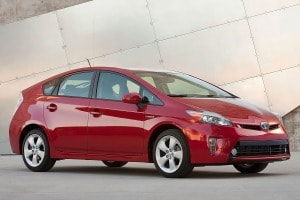
Plug-in hybrids and fuel-cell vehicles may well be the future, but until they come down considerably in cost, more traditional hybrids continue to rule the roost. In the US last year, Chevrolet's Volt attracted 23,461 buyers. The expanding Toyota Prius family, in contrast, found its way into 236,659 homes.
with Agence France-Presse, Reuters
This story was found at: http://www.smh.com.au/drive/motor-news/how-electricity-lost-its-spark-20130315-2g45r.html