by caratgmi

Fiat's latest TVC generates BIG hits

Online Shopping- Hotter than before?

Ever wondered what the WWW. SPHERE really looked like?

Showing posts with label Environment. Show all posts

Monday, 30 June 2014

GM Takes an Aggressive Step on Clean Transportation

GM - Clean Transportation

Automaker has ambitious plans when it comes to changing the face of transportation

General Motors recently announced that it has begun overhauling many of its operations in order to become more sustainable. This is a trend that is becoming increasingly common in the auto industry, especially as automakers begin to feel pressure from the world’s governments that are concerning with clean energy and emissions. Many governments are introducing new emissions standards that are specifically targeting transportation. This means that automakers are beginning to feel the need to produce environmentally friendly vehicles in order to retain their place in prominent markets around the world.

GM to restructure itself in  order to better navigate the challenges of climate change and energy security

General Motors will be restructuring its global vehicle portfolio as well as reworking its manufacturing process. The automaker will also begin working with numerous new partners in order to make use of new technology and become more environmentally friendly. General Motors notes that climate change and energy security have become major challenges for the auto industry as a whole and are no longer matters that are solely within the realm of politics and activism.

Automaker intends to transform transportation and bring 500,000 electric vehicles to the road

The automaker envisions its efforts as a way to “transform transportation.” General Motors aims to sell some 500,000 electric vehiclesby 2017 and believes that the demand for these vehicles is growing rapidly among consumers, businesses, and government agencies. The company has committed itself to reducing carbon emissions, especially in China, where air pollution has become a serious health problem.
GM will focus on battery electric as well as fuel cell vehicles in order to achieve clean transportation goals.
Currently, approximately 153,034 electric vehicles from General Motors are on the road. The demand for these vehicles has been modest in the past, but more consumers are becoming interested in clean transportation, especially as battery technology becomes more advanced and efficient. General Motors is not only interested in producing battery electrics, of course, and has plans to introduce fuel cell vehicles at some point in the relatively near future.
http://www.hydrogenfuelnews.com/gm-takes-aggressive-step-clean-transportation/8517978/

Monday, 26 May 2014

GM almost half way to goal of 25 percent energy reduction by 2019


GMenergy.jpg
A worker installs a light-emitting diode, or LED light at the General Motors assembly plant in Rayong, Thailand. GM has replaced older light bulbs with LEDs in order to save energy. (Courtesy photo)

General Motors Co. committed to reducing its energy and water use at 31 plants nationwide as part of a federal program that already includes competitor Ford Motor Co.
The Detroit-based automaker is one of 26 new partners to join the U.S. Department of Energy's Better Buildings Challenge, the Obama administration announced Friday.

President Barack Obama launched the program in 2011 with the goal of making commercial and industrial buildings at least 20 percent more energy efficient in the next 10 years. More than 190 companies, universities, school districts, multifamily housing organizations and state and local governments are now part of the program.

GM committed to reducing its energy intensity by 25 percent from 2008 to 2019 at 31 plants, along with a 20 percent reduction in water use by 2020. Energy intensity measures source energy use divided by the number of vehicles, engines or powertrain components produced. GM already has cut back its energy intensity by about 12 percent since 2008.
The company also has been recognized for having 63 facilities meeting an Energy Star challenge to reduce energy intensity by 10 percent within five years, more facilities than any other company worldwide.

"We see great value in ... benchmarking information so we know who the best is out there in terms of energy efficiency and of course greenhouse gas reduction and we can better target efficiency gains from those learnings," said GM spokeswoman Sharon Basel.
She said GM saves energy much like a homeowner would — making sure lights and equipment are turned off when not in use, and installing new LED lighting. It also uses solar power and landfill gas energy at some facilities.

Dearborn-based Ford previously committed to reducing its energy intensity at 24 plants by 25 percent from 2011 to 2022. It also sought a 30-percent cut in water use by 2015.
Ford and GM are among 20 companies, organizations or municipalities that are part of a new water savings pilot program that allow them to share water performance data, track progress and cut energy wasted from the inefficient use of water, according to the DOE.

"Whether it's investing in new technology or implementing rewards programs with employees, Better Buildings partners are not only creating cutting edge approaches to energy efficiency but they are also sharing their successes with the marketplace," U.S. Energy Secretary Ernest Moniz said in a statement.

Tuesday, 18 June 2013

Mercedes-Benz propels environmental efforts via mobile app

By  Published on June 6, 2013
http://www.luxurydaily.com/mercedes-benz-fetes-energy-saving-technology-via-mobile-app/
Mercedes BlueEFFICIENCY app
German automaker Mercedes-Benz is propelling environmental efforts through a new mobile application that shows off the energy-saving technology used in its vehicles.
The “BlueEFFICIENCY battery saver” mobile app helps Android users expand their smartphone’s battery life by mimicking the technology that Mercedes uses in its vehicles to save fuel. The automaker is likely aiming to create positive consumer experiences with the app that would translate to a positive experience with Mercedes.
“For the app to increase interest in Mercedes vehicles, it is critical that the app works well and provides a good customer experience, otherwise sponsoring this app and putting the brand’s name on it could backfire,” said Simon Buckingham, CEO of Appitalism, New York.
“Mercedes is associating a free app with a very expensive automobile,” he said. “I like the app’s tagline of ‘Mercedes-Benz technology in your pocket.’
“The reviews for this app are very positive, so this seems like the quality of the app enhances or matches Mercedes’ overall brand values.”
Mr. Buckingham is not affiliated with Mercedes, but agreed to comment as an industry expert.
Mercedes was unable to comment before press deadline.
The BlueEFFICIENCY battery saver app is available for free in Google Play.
Mobile efficiency
Mercedes is comparing the technology in the BlueEFFICIENCY mobile app to the BlueEFFICIENCY technology in its vehicles.
The app saves batter power in Android devices without impact on functionality.
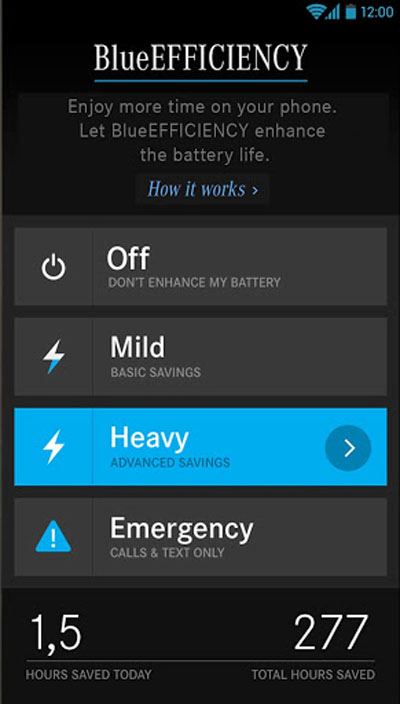
The main screen of the app gives consumers different options of battery saving technology. Users can choose between “mild” for basic battery savings, “heavy” for advanced savings and “emergency” for calls and texts only.
Also, the app shows users how many hours of energy they have saved today and in total since using the app.
Main screen
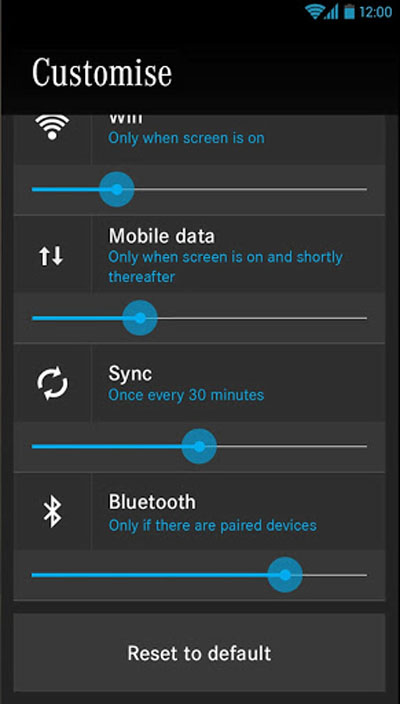
In each setting, consumers can customize specific options to get the most out of the battery-saving technology while still using the most important tools on their phone.
Settings
Additionally, the app gives consumers the chance to learn about the BlueEFFICIENCY technology in Mercedes vehicles.
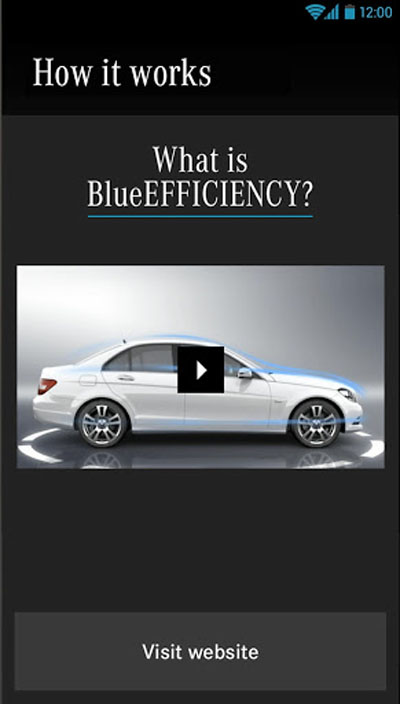
A click-through on the “How it works” button on the main screen takes consumers to a page where they can watch a video or visit the Mercedes Web site to learn more.
How it works
The app currently has a rating of 4.6 stars out of 5 in Google Play.
In your pocket
Mercedes has recently been upping its reach on mobile platforms. This is likely to help Mercedes reach a younger and more technology-savvy consumer group.
For instance, this spring the automaker created a mobile-optimized Web site to provide on-the-go consumers with branded content and media.
After overhauling its Web strategy in 2012 to offer a magazine-style site, Mercedes is optimizing the platform for smartphone users (see story).
Also, Mercedes flaunted its new 2014 E-Class vehicles through two banner advertisements on the CBS News mobile apps.
A click-through on the ads took consumers to a page where they can view details on the new E-Class vehicle (see story).
The energy-saver app takes the automaker’s mobile promotions to the next level by giving app users a positive experience associated with the brand.
Since many smartphones owners have issues with battery life, this app acts as a solution to a common problem.
“Managing battery life is a constant challenge for many smartphone users, so a useful app that extends battery life will likely generate positive goodwill and feelings from consumers using the app, which will benefit the Mercedes brand,” Mr. Buckingham said.

Automakers are greenest brands


LONDON: Toyota, Ford and Honda have topped the Interbrand 2013 list of 50 Best Global Green Brands, with Nissan and Volkswagen also appearing in the top ten.

The brand consultancy looked at the gap that exists between a company's environmental performance, as assessed by Deloitte, and public perception of the brand's green credentials, produced by Interbrand's consumer research.

Toyota, leading the list for the third year running, continues to dominate the hybrid market with its Prius model. Carmakers that created innovative products to prove their commitment to sustainability, as Ford did with EcoBoost and Nissan with LEAF, benefited accordingly in consumer perception.

Toyota went further, however, examining the future of mobility by developing a low carbon community called the Toyota Ecoful Town in Toyota City.

"What makes the annual
Best Global Green Brands report unique and valuable is that it examines performance and perception in action," said Jez Frampton, Global Chief Executive Officer of Interbrand. This, he added, enabled corporations to plan strategies to move forward.

The technology category dominated the overall report with 12 brands appearing. Panasonic was the most prominent, at fourth, offering innovative, eco and smart solutions said Interbrand.

David Pearson, head of global sustainability at Deloitte's, noted that sustainability issues continued to rise up the business agenda.

Nowhere was this more clear than with clothing and retail companies, with the report noting that social media communities were keeping a close eye on factory safety throughout the world in the light of the
Bangladesh factory collapse.

Adidas (15th on the list), Nike (31st), H&M (42nd) and Zara (48th) were the top apparel brands, and all are using supply chain reform not just to cut costs, as before, but to make a statement to consumers about what they stand for.

Data sourced from Interbrand; additional content by Warc staff,, 13 June 2013

Sunday, 25 November 2012


A- A A+
Paper Edition | Page: 9
It’s raining money: A man washes a car at a car wash in Permata Hijau, South Jakarta. The rainy season sees more customers having their cars washed at such businesses by paying Rp 12,000 to Rp 75,000, depending on the service. (JP/R. Berto Wedhatama)It’s raining money: A man washes a car at a car wash in Permata Hijau, South Jakarta. The rainy season sees more customers having their cars washed at such businesses by paying Rp 12,000 to Rp 75,000, depending on the service. (JP/R. Berto Wedhatama)
The rainy season might make Jakarta motorists sigh over gridlock on inundated roads and grime-coated cars after pouring rain. For car wash businesses in the capital, however, the season is a gold mine that keeps rainy days at bay.

Crusted soil and dirt drives more customers through their doors, and more dough into their pockets.

Rochman Iroyo, who owns an automated car wash on Jl. Pramuka in East Jakarta, said that his business saw 150-250 customers lined-up to get dirt cleaned off their cars a day after the rain. During a bright, sunny day, he sees between 100-150 daily visitors.

Ross, who owns an eponymously named 24-hour car wash in Cempaka Putih in Central Jakarta, echoed Rochman. She said her business saw 120-150 cars drive through her gate after downpour. She added that normally, she only had around 100 customers daily.

Downpour might double their profit, but car wash businessmen say that with or without rain, getting dirt off Jakartans’ vehicles is a lucrative business.

The reasons are simple, they say. With the nation’s stable economic growth, more and more Jakartans are able to purchase cars. Hectic lifestyles, however, inhibit them from washing their cars themselves. As a result, many car owners are attracted to car washes for their ability to clean their cars fast and efficiently.

The Indonesian Automotive Industry Association (Gaikindo) earlier this month revealed that car sales nationwide between January and October sat at 923,132 units, toppling 2011 annual sales at 894.164 units. Jakarta Police data also shows that the numbers of vehicles on the road has been rising by 11.26 percent every year.

Rochman, for instance, said that he was inspired to establish his business in 2004 after seeing how a car wash business he frequently dropped by was never seen sparsely visited. “There are more and more cars in Jakarta every year,” he thought to himself. “Moreover, Jakarta’s urban people love to show off their fancy look with clean and shiny cars and I won’t have to worry about a drought in customers. This might score me a great business.”

Rochman then decided to spend up to Rp 1.5 billion (US$155,763)to establish his own business, including buying an automated, drive through car wash machine.

The business is a proven money maker, as the man could reap Rp 4.5 million to Rp 11.25 million gross a day, depending on rain or shine. He charges his visitors Rp 45,000 for a wash.

Rochman refused to disclose how much he spends to operate daily, simply adding that the profit “is more than enough to pay my 30 workers and cover all the bills”.

Establishing the fat business, however, does not always require a hefty bank account or sophisticated equipment.

Ross, for instance, started her business in her yard with rubber tubes, buckets, sponges, polishing wax and car shampoos back in 1997. Now in 2012, only two vacuum cleaners used to clean car interiors have been added to her equipment stock.

Ross said the business was unintended. She leased her yard as a taxi pool back then, and washed some of the cabs by request.

“Many private cars passing stopped and asked to have their cars washed too,” she said.

That was when she decided to open a car wash service and hired her neighbors as employees.

She can now garner a minimum of Rp 1.3 million daily by charging Rp 13,000 for a service and spends only Rp 2 million for equity bills, Rp 300,000 for polish wax monthly and Rp 60,000 daily for car-shampoos.

The rewarding business, Rochman and Ross say, of course attracts more people to profit from it. Rochman said there were only around 10 automated car wash businesses when he first established his business, but he now had around 30 competitors running similar services.

Ross, on the other hand, said that she was the first to run a car wash business in the area before her neighbors started to follow suit. “Now there are seven,” she said.

Rochman and Ross, however, said that there is not much to worry about. “There are more and more cars in the capital and never enough car washes. Customers also have their own preference on where they like to get their cars washed,” he said.

Arum, 26, said that she preferred an automated car wash as it offered her faster service compared to other car washes. “It’s okay to pay more as long as it quick,” she said. Rahma, 26, a resident of Pejaten, South Jakarta, said that she loved to have her car washed near her house not only for the short distance, but also for the services it offer.

“They offer customers free drinks while waiting. They also cleanse my car’s pit,” Rahma explained.

While Erik, 30, said he always has his car cleansed and rinsed at Ross’s car wash as he always passed it on his way from work on Jl. Gatot Subroto, South Jakarta.

Location plays an imminent role in determining whether the business will succeed or fail, Rochman says.

“Choose a location that is passed by people coming home from work. Don’t worry if you have to spend a lot of money on rent because soon enough, the money will come back to you,” he said. (aml)

Monday, 19 November 2012


Green Marketing Drives Consumer Auto Consideration, Purchases

Published in Nielsen Blog on November 15, 2012 Nielsen

Nielsen research shows that green marketing by automakers effectively drives customers to the showroom.  Ford, Honda, Toyota, Chevrolet and Nissan have taken that idea to heart—and are now finalists for the third annual Nielsen Automotive Green Marketer of the Year award. Recognizing the brand that made the greatest strides to both gain consumer awareness and positively impact consumer perceptions around the automotive industry’s environmentally friendly initiatives, the award will be presented at the Los Angeles International Auto Show on November 29.
http://blog.nielsen.com/nielsenwire/wp-content/uploads/2012/11/green-auto-charts-11.png
In 2012, the impact of green advertising  on purchase consideration was 20 percent higher among consumers compared to 2011.  Environmentally friendly features are also gaining steam. Of particular note, 76 percent of consumers interviewed said that high fuel efficiency and MPG is something a vehicle must have to be considered for purchase.


http://blog.nielsen.com/nielsenwire/wp-content/uploads/2012/11/green-auto-charts-21.png
“The topic of green marketing continues to gain momentum and is critical for a brand to be considered by today’s consumer,” said Lois Miller, president, Nielsen Global Automotive. “Our research identifies how effective auto manufacturers are in raising awareness of their green products, initiatives and innovations. We can then understand if they were able to change perceptions and consideration in a positive way among consumers.”

Methodology
In order to determine the finalists and winner, Nielsen leveraged three research studies to incorporate awareness levels and perceptions across media types. The studies included:

  • A custom survey of nearly 2,600 consumers’ cross-media awareness and perceptions of environmental messages by automotive brand
  • Response data from 6 million viewers of national television advertising collected by Nielsen’s ad effectiveness measurements service, focusing on green automotive ads
  • Measuring social media “buzz” sentiment within green-related discussion threads, based on over 115,000 social media messages
Auto manufacturers that ran any national TV ads with green themes between October 2011 and September 2012 were eligible for consideration.
Aegis Media 2012. Powered by Blogger.